Guides · · 9 min read
Versatile Gym Wear for Office: A How-To Guide
Build a gym wear for office rotation that passes dress codes and handles training. Practical formulas, fabric tips, and care advice for busy professionals.

Table of Contents
- Why Versatile Gym Wear for Office Works
- Office Dress-Code Compatibility: What Actually Passes
- Building Business Casual Athleisure Outfits That Read as Professional
- How to Style a Gym Shirt for Work Without Looking Like You Just Trained
- Gym to Office Outfit Ideas for Every Weekday
- Layering and Quick-Change Strategies for Tight Schedules
- Fabric, Fit, and Care: Making Athleisure for Work Last
- Frequently Asked Questions
Last Updated: October 6, 2026
Why Versatile Gym Wear for Office Works
Versatile gym wear for office works because it removes one decision from a crowded morning. You train early, you have a meeting at nine, and you do not want to carry three outfits or change twice.
The logic is simple. Athleisure for work is clothing that meets two standards at once: it moves the way training clothing needs to move, and it reads as considered rather than casual in a workplace setting. That second standard is where most wardrobes fail.
What most guides miss is that the problem is rarely the garment. It is the combination. A plain short-sleeve crew neck tee is office-ready under a structured layer and out of place on its own. The same piece behaves differently depending on what sits over it.
Below, we cover dress-code limits, four outfit formulas, layering for tight schedules, and how to judge cloth so it survives both jobs.
Office Dress-Code Compatibility: What Actually Passes
Most workplaces fall into three bands, and each one draws the line in a different place.
- Formal: Suiting is expected. Activewear does not belong here, and no amount of styling will change that.
- Business casual: The realistic target. Clean lines, covered shoulders, structured outer layer, no visible branding.
- Smart casual or creative: The widest band. Leggings and knit pants pass comfortably when paired with a proper top and shoe.
Three practical rules decide whether a piece clears the bar:
- Coverage. Shoulders covered, midriff covered, nothing sheer under office lighting.
- Structure. At least one element with a defined shape, such as a collared or zip-through jacket.
- Quiet branding. A small tonal emblem disappears. A large logo does not.
Check your own workplace policy before buying anything. Many organisations publish their dress expectations in an onboarding handbook, and it is the only authority that matters for your building.
Building Business Casual Athleisure Outfits That Read as Professional
Business casual athleisure outfits read as professional when the fabric and silhouette do the work, not the branding. Matte finishes, full-length cuts, and simple shapes look intentional.
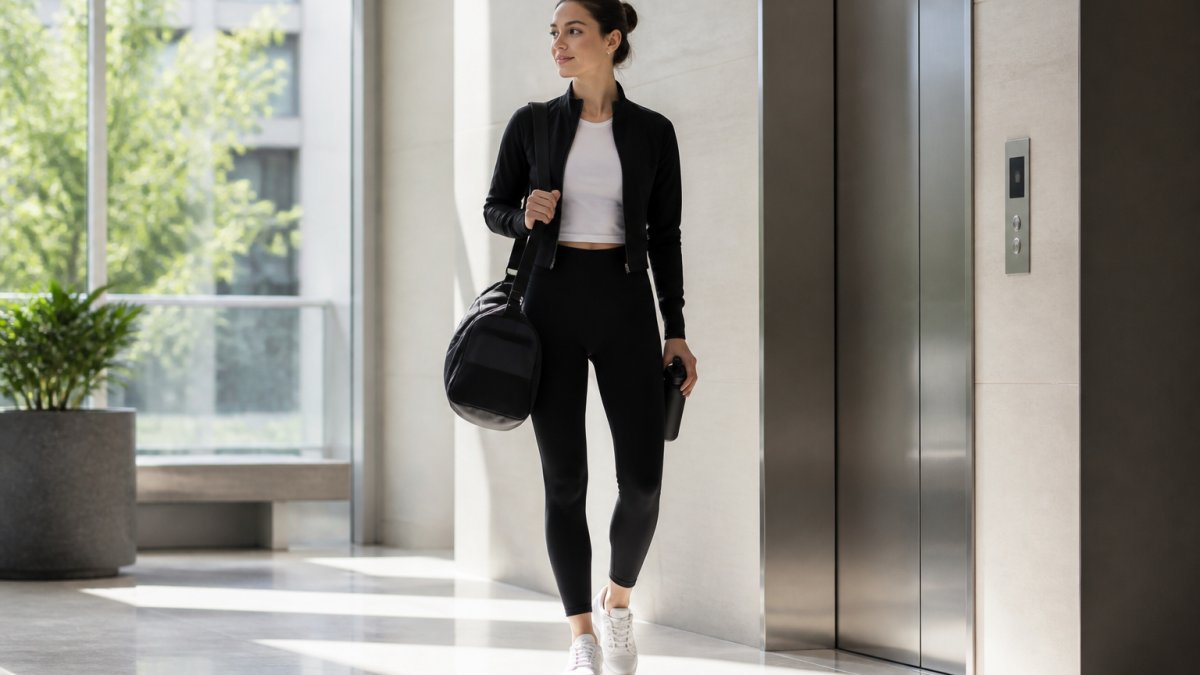
Start with the bottom half, because it carries the most visual weight. High-waisted pants in a matte finish hold a clean line and sit well under a jacket.
Then choose the top. A plain tee with a crew neck is the safest base in the category. Keep it fitted enough to layer without bunching, but not so tight that it pulls across the chest.
Finish with a layer that has a collar or a zip. This is the single highest-use move.
How to Style a Gym Shirt for Work Without Looking Like You Just Trained
Styling a gym shirt for work comes down to three changes: layer it, tuck it, and change the shoe. The shirt itself is usually fine. What gives it away is everything around it.
Layer it. An open jacket or overshirt breaks up the training silhouette and adds a collar line.
Tuck or half-tuck it. A defined waistline reads as deliberate. An untucked hem over leggings reads as post-workout.
Change the shoe. A clean low-profile sneaker in a single colour works. A bulky trainer does not.
Add one structured accessory. A leather bag or a metal watch shifts the whole outfit toward work.
Keep a spare plain tee folded in your bag. Swapping the top solves most of the “just trained” problem without a full change.
Gym to Office Outfit Ideas for Every Weekday
Gym to office outfit ideas work best when you plan by day type rather than by garment. A simple weekly rotation: a plain crew neck tee under a zip-through jacket for a meetings-heavy Monday; a short-sleeve tee with an open overshirt for desk and site days; a tank under a full-zip jacket for training-heavy days; a plain tee with a cropped zip jacket for client-facing afternoons; and a tee or tank with a lightweight jacket on relaxed-dress-code Fridays. Pair each with a clean, low-profile sneaker.
The pattern is consistent. One quiet base layer, one structured outer layer, one clean shoe. Once you have that formula, the specific pieces matter far less than the combination.
Three practical rules make the rotation work across different workplaces:
- Match the layer to the dress code, not the base. In a business-casual office, the zip-through jacket or overshirt is non-negotiable. In a smart-casual or creative office, you can drop the structured layer on Fridays and still look intentional.
- Keep the shoe consistent. A single-colour low-profile sneaker in black, navy or white reads as smart casual in most offices. A bulky trainer with visible cushioning does not, regardless of what you wear above it.
- Plan the change, not the outfit. If your building has showers, Monday and Thursday are your heavy-training days because you can rinse and reset. If it does not, keep Wednesday and Friday for lighter sessions and use the spare-base-layer swap on the others.
What this rotation deliberately avoids is the trap of treating every day the same. A Monday with back-to-back meetings needs a different layer from a Friday with a relaxed dress code, even if the base layer is identical. The table is a starting point; adjust the structured layer up or down to match your workplace's actual expectations.
Layering and Quick-Change Strategies for Tight Schedules
Layering is what makes the office-to-gym transition fast, because you are removing clothing rather than replacing it.
Build every outfit in three layers:
- Base: the piece you train in. Plain, breathable, close to the body.
- Mid: the piece that makes it office-appropriate. Structured, with a collar or zip.
- Outer: optional, for cold mornings or formal rooms.
The transition then takes one step. Remove the mid layer and you are in training clothing. Add it back and you are presentable again.
Two logistics points matter more than styling:
- Where you change. If your building has showers, use them. If not, a quick wipe-down and a fresh base layer covers most situations.
- What you carry. A slim bag with one spare base layer, deodorant, and a small towel handles almost every scenario.
Fabric, Fit, and Care: Making Athleisure for Work Last
Fabric performance versus professional appearance is the trade-off at the centre of this whole approach, and it is worth understanding before you spend. The right question is not "is this performance fabric?" but "does this fabric hold a polished line after a commute and a training session?"
Four properties decide whether a piece clears both bars. Test them in this order:
- Opacity. Hold the fabric up to a window or a phone torch. If you can see your hand through it, it will show under office lighting and after a stretch. Matte, midweight knits pass; thin, shiny performance fabrics usually fail.
- Stretch recovery. Pull the fabric across the knee or elbow and release. Good recovery means it snaps back without a bagged shape. Poor recovery means the garment looks tired by mid-afternoon, which reads as gym wear regardless of cut.
- Wrinkle resistance. Scrunch a section in your fist for ten seconds and let go. If it holds creases, it will look creased after a car or train commute. Matte knits and heavier cotton blends generally recover better than lightweight synthetics.
- Odour control. Quick-dry synthetics manage moisture well but can hold odour longer than natural fibres. A common pattern is to use performance fabric for the base layer you train in and a matte knit or cotton blend for the structured layer that sits closest to other people in meetings.
Lightweight, low-gsm performance fabrics handle sweat well but often look technical. Heavier cotton and matte midweight knits look better in an office but take longer to dry. The practical answer is a mix: lighter base layers, matte mid layers, and a structured outer layer that never touches sweat.
Care decides cost per wear. A few habits extend the life of anything you train in:
- Wash cold, and turn printed or logo pieces inside out.
- Hang to dry rather than tumble drying, which breaks down stretch fibres over time.
- Do not iron over prints or emblems.
- Rotate at least three base layers so no single piece is washed daily.
- Wash structured layers less often than base layers; they sit further from the body and last longer between washes.
Quiet Unity makes a small range built around this idea: matte, quietly branded pieces designed to move between training and daily wear.
One honest limitation: heavier cotton takes longer to dry after a hard session than a synthetic performance fabric. If you train twice a day, plan your rotation accordingly.
Frequently Asked Questions
Can you wear gym clothes to the office?
It depends on your workplace dress code. In business-casual offices, plain leggings in black or navy paired with a structured jacket, a tucked-in plain tee, and clean loafers or minimal sneakers usually pass. Avoid visible logos, bright colour-blocking, and sheer fabrics. The key is that the outfit reads as intentional rather than as something you forgot to change out of after training.
How do you make activewear look professional?
Choose plain, minimal-branding pieces in dark, matte fabrics. Layer a cropped or structured jacket over your base, add a belt or tucked hem to define the waist, and finish with polished shoes. High-waisted full-length leggings in black or ink blue work better than patterned or cropped styles. Keep jewellery simple. The overall silhouette should be closer to tailored casual than to gym-floor gear.
What should you wear over gym clothes for work?
A midweight zip jacket, an overshirt, or a relaxed blazer works well over a plain gym tee or tank. For leggings, a longer jacket or tunic that covers the hip gives a more office-appropriate line. A cropped track jacket in a matte finish adds structure without bulk. Keep the outer layer plain and logo-free so the whole outfit reads as one considered look rather than gym kit with a jacket thrown over it.
How do you transition from a workout to work without changing your whole outfit?
Build your outfit around pieces that work in both settings: plain high-waisted leggings, a midweight crew neck tee, and a zip jacket. After training, swap your shoes, refresh with a quick wipe-down, add your outer layer, and adjust your hair. Keep a small kit in your bag with deodorant, face wipes, and a compact mirror. The base layers stay on; only the finishing pieces change.