Guides · · 10 min read
Heavyweight vs Lightweight Cotton Oversized T-Shirts
Compare cotton oversized t-shirts by GSM, breathability and drape to see which weight suits training or daily wear. Learn how to pick and care for yours.

Last Updated: November 15, 2026
Quick Summary
Heavyweight cotton oversized t-shirts (240+ GSM) hold a boxy shape, resist wear and stay opaque, while lightweight cotton oversized t-shirts (under 180 GSM) breathe better and drape closer to the body. For structure choose 240-280 GSM; for hot sessions or training choose 150-180 GSM.
- GSM measures fabric density and strongly influences how a tee drapes and holds its shape.
- Below 150 GSM an oversized cut tends to look limp and cling in the wrong places.
- Above 300 GSM the garment becomes stiff and heavy for daily wear.
- Wash heavyweight cotton inside out in cold water and air dry or tumble on low.
- When layering, put the lighter 150-180 GSM tee underneath and the heavier tee on top.
Table of Contents
- Heavyweight vs Lightweight Cotton Oversized T-Shirts: The Core Differences
- Quick Comparison: Heavyweight vs Lightweight Oversized Tees
- Finding the Best GSM for Oversized T-Shirts
- Are Heavyweight T-Shirts Breathable Enough for Training?
- Drape, Structure and Shape Retention in Oversized Fits
- How to Wash Heavyweight Cotton T-Shirts Without Shrinking
- Layering, Body Type and Styling Versatility
- Choose Your Weight at Quiet Unity
- Frequently Asked Questions
Heavyweight vs Lightweight Cotton Oversized T-Shirts: The Core Differences
The difference between heavyweight and lightweight cotton oversized t-shirts comes down to fabric weight, measured in GSM, and how that weight changes drape, breathability and durability. Heavier cotton holds a boxy shape and resists wear; lighter cotton breathes better and falls closer to the body.
GSM, or grams per square metre, is the metric used to express fabric weight. It tells you how much cotton sits in a square metre of cloth, which strongly influences how a tee drapes and holds its shape on the body.
What GSM Actually Measures
GSM measures fabric density, not thickness alone. A 180 GSM cotton jersey and a 275 GSM cotton jersey can look similar on a hanger, but the heavier cloth packs more fibre into the same area. That extra fibre density is what gives a garment its hand-feel, its opacity and its tensile strength. Lighter cloth under 180 GSM tends to be translucent in pale colours and softens quickly with washing. Heavier cloth above 240 GSM feels substantial, resists stretching at the neckline and keeps its shape retention through repeated wash-and-wear cycles. Neither is better in the abstract.
How Weave and Yarn Count Change the Feel
Two tees at the same GSM can feel completely different. Yarn count describes how fine the individual threads are: a finer yarn count produces a smoother, softer surface, while a coarser yarn gives a drier, more textured hand-feel. Weave matters too. A tight cotton jersey knit with combed cotton creates a smooth print surface and a clean silhouette, which is why premium cotton blanks are popular for DTG printing and decoration. A looser knit lets more air through, improving breathability at the cost of opacity. This is why you cannot judge a tee by weight alone.
Quick Comparison: Heavyweight vs Lightweight Oversized Tees
Heavyweight cotton wins on structure and durability; lightweight cotton wins on breathability and summer comfort. The table below maps the trade-offs so you can pick by use case rather than by marketing copy.
| Attribute | Heavyweight (240+ GSM) | Lightweight (under 180 GSM) |
|---|---|---|
| Drape and structure | Holds a boxy cut away from the body | Falls close to the body |
| Breathability | Moderate; traps more warmth | High; moves air freely |
| Durability | High tensile strength, slow to wear | Softens and thins faster |
| Shape retention | Resists stretching at neck and shoulder | Can lose shape with heavy washing |
| Opacity | Opaque, even in pale colours | Can be translucent in light tones |
| Best season | Cooler months, layering, gym-to-office | Hot summer rotation, base layers |
| Shrinkage risk | Low when preshrunk | Moderate unless preshrunk |
| Printing | Smooth, stable surface for DTG | Can distort under heavy ink |
For most people building a year-round wardrobe, the answer is not one weight. It is a heavy tee for structure and a lighter tee for heat.
Finding the Best GSM for Oversized T-Shirts
The best GSM for oversized T-shirts sits between 240 and 280 GSM for structure, and between 150 and 180 GSM for breathability. Below 150 GSM, an oversized cut tends to look limp and cling in the wrong places. Above 300 GSM, the garment becomes stiff and heavy for daily wear.
Here is how we would choose, by priority:
- You want the boxy silhouette to hold: aim for 240-280 GSM. The fabric has enough body to sit away from the torso without collapsing.
- You train hard and sweat a lot: aim for 150-180 GSM, or a midweight around 200 GSM with a moisture-wicking finish.
- You want one tee for gym and office: 240-275 GSM works if the cut is relaxed, because the structure reads as intentional rather than gym-focused.
- You live in a hot climate: go lighter, and accept that the drape will be closer to the body.
- You print graphics: heavier, smoother cloth holds DTG ink with less distortion.
Are Heavyweight T-Shirts Breathable Enough for Training?
Heavyweight T-shirts can be breathable enough for training, but only when the knit structure and fit work together to move moisture and air.
Three construction variables decide whether a heavy tee breathes:
- Knit density. A tighter knit blocks airflow. Look for a jersey knit with visible porosity rather than a compacted surface. Combed cotton can be knit either tight or open, the fibre preparation does not dictate the knit.
- Yarn count. Finer yarns create a smoother surface but can pack more densely. Coarser yarns leave more air space between threads, which improves ventilation at the cost of a drier hand-feel.
- Fit and cut. An oversized drop-shoulder cut keeps fabric off the skin and allows convective airflow. A slim heavy tee defeats the purpose.
A practical way to judge a heavy tee for training is to hold it up to a light source. If you can see a fine, even glow through the fabric, the knit is open enough to ventilate. If it blocks light completely, expect it to run warm.
Watch out: a heavy tee that fits snugly across the chest and back will feel far hotter than the same GSM in a relaxed cut, so do not judge breathability by weight alone. If you want a fuller breakdown of fabric weight by season, read our guide to gym wear for an Australian summer.
Drape, Structure and Shape Retention in Oversized Fits
Drape describes how fabric falls over the body, and it is where heavyweight cotton earns its keep. Heavy cloth has the mass to hang in clean lines, so an oversized fit looks deliberate rather than shapeless. Light cloth drapes closer, which flatters some body types and exposes others.
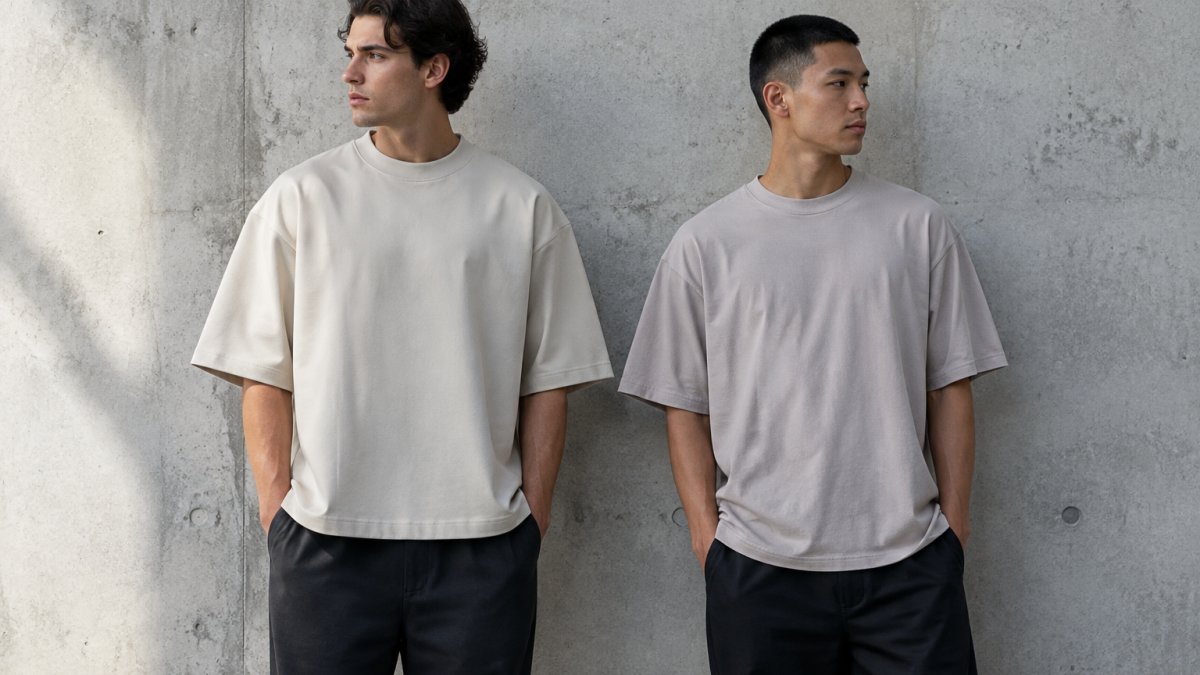
Shape retention is the long game. If you are unsure how an oversized cut will sit on your frame, our guide to sizing oversized and boxy fits with flat measurements walks through pit-to-pit, length and shoulder measurements.
How to Wash Heavyweight Cotton T-Shirts Without Shrinking
Wash heavyweight cotton T-shirts inside out in cold water on a gentle cycle, then air dry or tumble on low. Heat is what shrinks cotton and breaks down fibre density, so keep the temperature down and skip the dryer where you can.
A practical routine:
- Turn inside out to protect the surface and any print.
- Cold wash, gentle cycle. Hot water relaxes the knit and invites shrinkage.
- Mild detergent only. No bleach, no fabric softener, which coats the fibres.
- Air dry flat or on a hanger. If you must tumble, use low heat and remove while slightly damp.
- Iron on low, inside out. Never iron directly over a print.
Preshrunk heavyweight cotton shrinks far less than untreated cloth, but no cotton is shrink-proof. Wash cold, dry low, and a good tee keeps its fit for years. For the full method, see our step-by-step guide on how to wash heavy cotton apparel.
Layering, Body Type and Styling Versatility
Layering is where weight choice becomes a system rather than a single purchase, and it is the area most guides ignore. The rule is counter-intuitive: the lighter tee goes underneath, the heavier tee goes on top.
The mechanics matter. When you layer a heavy tee over a light one, the heavy fabric's mass keeps the outer hem and shoulder line clean, while the light base sits flat against the skin and manages moisture.
Body type changes the calculus more than most guides admit. The goal with an oversized fit is to control where the fabric breaks and how much volume reads at each point:
- Broader shoulders and chests: a 240-275 GSM boxy cut with a dropped shoulder balances the upper body because the structure holds the tee away from the torso rather than clinging to it. Avoid lightweight oversized tees that drape close and emphasise width at the waist.
- Leaner frames: a lighter oversized tee (150-180 GSM) can work without swamping the silhouette because it falls closer to the body and creates a softer line. A heavy tee on a lean frame needs a deliberate boxy cut, or it reads as borrowed clothing.
- Shorter frames: heavy cloth adds visual weight and can shorten the leg line if the tee runs long. Aim for a 240-260 GSM tee with a hem that sits at mid-fly, not below.
- Taller frames: heavier cloth (260-280 GSM) helps keep length and shape, and a dropped shoulder prevents the tee from looking narrow through the chest.
- Stomach or midsection: a midweight 200-240 GSM oversized tee with a straight hem skims rather than clings. Very heavy cloth can stand away from the body and add bulk, while very light cloth reveals every line.
Styling versatility is the quiet advantage of a well-cut heavy tee.
Watch out: layering two heavy tees together creates bulk at the neck and waist and defeats the thermal-regulation benefit, keep one layer light and one heavy. If you plan to layer through cooler months, our seven steps to layering gym clothes for cold weather covers the mechanics.
Choose Your Weight at Quiet Unity
Picking your weight is the last decision, and the simplest. If you want structure, durability and a boxy cut that holds, go heavy. If you want maximum breathability for hot sessions, go lighter.
At Quiet Unity, we design in Melbourne and build our oversized tees from premium heavy cotton.
Every piece is made to order, so allow roughly a week for production before tracking arrives. Browse the full T-Shirts range to compare weights and fits side by side.
The hardest part is not choosing a weight. It is finding a tee that holds its shape after a year of training and washing.
Frequently Asked Questions
What is the difference between heavyweight and lightweight cotton T-shirts?
The main difference is fabric weight, measured in GSM (grams per square metre). Lightweight cotton sits roughly between 120 and 180 GSM, giving a thin, fluid hand-feel. Heavyweight cotton starts around 220 GSM and climbs past 300 GSM, which produces a denser, more opaque cloth with stronger structure and drape. For cotton oversized t-shirts, that weight gap influences how the garment falls on the body and how much warmth it holds.
Are heavyweight cotton T-shirts hotter to wear than lightweight ones?
Yes, a heavier cloth holds more heat because there is more fibre between you and the air. That works against you in summer training but in your favour in cooler conditions and during lower-intensity sessions. If you run hot, a midweight around 180-220 GSM is a practical middle ground. If you train in air conditioning or wear the tee mostly outside the gym, the extra warmth of a 275 GSM piece like the Oversized Pump Tee is rarely a problem.
Do heavyweight cotton T-shirts last longer?
Generally yes. Higher fabric density and double needle stitching slow down the wear that comes from repeated washing and training. Heavier cotton also resists the thinning and translucency that shows up quickly in lightweight jersey. Preshrunk fabric, as used in the Unity Classic Oversized Tee, reduces shrinkage after washing. The trade-off is drying time: a 275 GSM tee holds more water and takes longer to air dry than a 150 GSM one.
How do you wash heavyweight cotton T-shirts without shrinking them?
Wash cold on a gentle cycle at 30°C, turn the tee inside out and skip the bleach. Avoid the dryer or use a low tumble setting only, because heat is what drives shrinkage and breaks down cotton fibres. Dry flat or hang in shade rather than direct sun. Iron at low temperature if needed and never dry clean. Following these steps protects shape retention and keeps the drape of an oversized fit intact over years of wear.
Which cotton weight is best for an oversized T-shirt?
For a true boxy silhouette, heavyweight cotton in the 240-300 GSM range works best because the fabric has enough body to stand away from the torso instead of clinging. Lighter cotton tends to collapse into a relaxed, closer fit, which suits a softer look but loses the structured oversized profile. If you want the shape to hold through repeated washing, look for preshrunk heavyweight cotton with double needle stitching, such as the Unity Classic Oversized Tee.
