Guides · · 11 min read
How to Dress Broad Shoulders Casually
Master casual dressing for broad shoulders. Learn necklines, tops, layering, and outfit formulas that flatter and balance your silhouette.

Table of Contents
- Understanding Broad Shoulders and Visual Balance
- Best Tops for Broad Shoulders
- Necklines That Flatter Broad Shoulders
- Creating Balanced Casual Outfits for Broad Shoulders
- Layering and Jackets for Broad Shoulders
- Waist Definition and Strategic Tucking
- Fabric, Fit, and Construction Details That Matter
- Frequently Asked Questions
Last Updated: October 21, 2026
Understanding Broad Shoulders and Visual Balance
When you dress broad shoulders casually, it's about creating proportion and balance.
At Quiet Unity, we design pieces for people who value fit and durability across body types, focusing on heavy cotton construction and cuts that work with your frame.
The challenge is knowing what "fits well" means: size up for your shoulders and the garment is oversized everywhere else; stick with your regular size and you feel restricted.
Best Tops for Broad Shoulders
The right top is the foundation of any casual outfit when you have broad shoulders. Fabric, fit, and construction matter more than most people realise.
Fitted sleeves and structured fabrics
Fitted sleeves that taper at the wrist create definition without adding bulk at the shoulder, drawing the eye downward and preventing pulling across your chest.
Structured fabrics hold their shape and don't cling. Heavy cotton, like Quiet Unity's Classic Oversized Tee, resists stretching and maintains clean lines, while lighter fabrics pull and shift across broad shoulders.

Look for tops with:
- Double-needle stitching for durability
- Preshrunk fabric that won't stretch out
- Smooth surfaces that drape cleanly
The Unity Heavy Faded Long Sleeve offers dropped shoulders with cuffed sleeves for balanced proportion; the fabric weight prevents clinging and the cuff anchors the sleeve visually.
Oversized and dropped shoulder designs
Oversized tops work for broad shoulders when they're intentional. A boxy silhouette with dropped shoulders distributes volume evenly and avoids pulling across your chest.
Quiet Unity's Classic Oversized Tee uses 6.5 oz heavy cotton with a boxy modern silhouette and dropped shoulder design, preventing bunching or pulling across broad shoulders.
Oversized doesn't mean sloppy. Pair an oversized top with fitted or structured bottoms to create balance.
Necklines That Flatter Broad Shoulders
The neckline is the strongest lever over how wide your shoulders read. It controls the direction the eye travels across your upper body and how much horizontal line sits at your shoulder point. Get it right and a simple tee looks intentional; get it wrong and even a well-made top fights your frame.
What to Wear If You Have Broad Shoulders (Like Me)
Austine Ortencio | The Aurtencio Edit
How necklines change the shoulder line
Horizontal necklines, boat necks, square necks, wide scoop necks, run parallel to your shoulder line and visually extend width.
Stylists treat the neckline as a counterweight: the wider the shoulder, the more vertical or diagonal the neckline should be. That's a guideline, not a rule, if you like a boat neck, pair it with a fitted sleeve and structured fabric so the horizontal line stays crisp.
Neckline-by-neckline guide for casual tops
- Crew neck: Safe and versatile, but a high, narrow crew can make broad shoulders look boxy. A slightly wider, lower crew, sitting just below the collarbone, reads more balanced.
- V-neck: The strongest casual option for broad shoulders. The V creates a vertical line that lengthens the torso and narrows the shoulder span visually. A shallow V works for everyday; a deeper V suits evenings and layering.
- Scoop neck: A deep scoop does the same inward-and-downward work as a V but with a softer line. A wide, shallow scoop can emphasise width, so favour depth over width.
Fabric and fit decide whether a neckline works
A neckline only behaves as intended if the fabric supports it. Thin, stretchy jersey pulls across broad shoulders and turns a clean V into a strained one.
Fit at the shoulder seam matters too. A seam exactly on your shoulder point will pull when you move; a slightly off-shoulder or dropped-shoulder cut gives room without strain. If you're between sizes, size for the shoulders and use tucking or a belt to bring the waist back in.
Adapting to your proportions, not just your shoulder width
Broad shoulders don't occur in isolation. How a neckline reads depends on your bust, waist, and hip proportions:
- Fuller bust: A deeper V or scoop gives the bust room and avoids the strained look a high crew can create.
- Narrow waist: You have more freedom, a V-neck tucked into a fitted waist plays up the contrast, and a boat neck can work because the waist definition stops the horizontal line from dominating.
- Straighter waist and hip: Vertical necklines are your friend. A V-neck or deep scoop creates the diagonal line a straighter silhouette lacks.
The goal is not to minimise your shoulders but to choose necklines that make the whole outfit read as intentional.
Creating Balanced Casual Outfits for Broad Shoulders
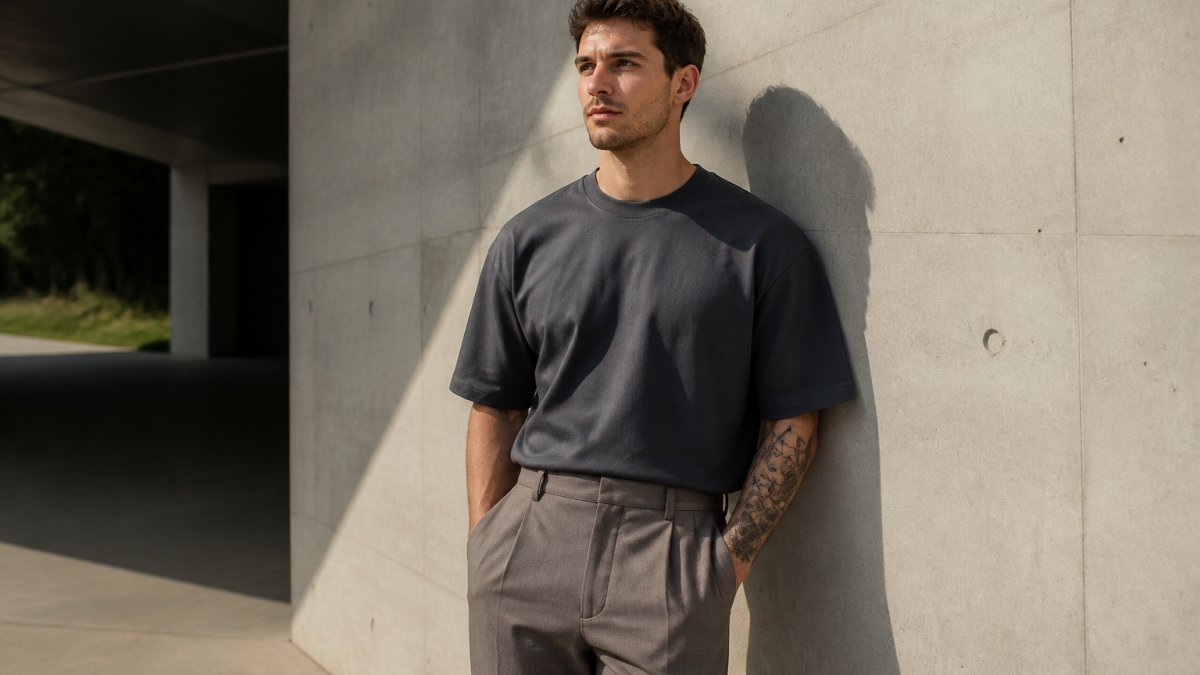
Balance is the core principle of dressing broad shoulders well: if your top is loose, your bottoms should be fitted; if your top is fitted, your bottoms can be looser.
Proportional bottoms and silhouette balance
Your bottoms anchor your outfit. Structured trousers, fitted jeans, or tailored shorts create visual weight at the bottom of your silhouette, balancing width at the shoulders.
With an oversized top, choose bottoms fitted through the hip and thigh, tapered at the ankle, and made from substantial fabric that holds its shape.
When you wear a fitted top, you have more flexibility with bottoms.
Outfit formulas for different occasions
Casual weekend: Oversized top + fitted jeans + trainers. The Quiet Unity Classic Oversized Tee works perfectly here.
Work-adjacent casual: Fitted long-sleeve top + structured trousers + simple shoes. The Unity Heavy Faded Long Sleeve with its dropped shoulders and cuffed sleeves creates definition.

Layered casual: Fitted tee + oversized overshirt or jacket + fitted bottoms.
Relaxed at home: Oversized crew + relaxed trousers + socks.
Layering and Jackets for Broad Shoulders
Layering adds visual interest and lets you control how much volume sits at your upper body. A fitted base layer under a looser overshirt creates balance: the fitted layer defines your frame, and the looser layer adds volume without making you look oversized.
Jackets work best when they fit through the shoulders without pulling. An oversized jacket that drapes cleanly beats a fitted one that strains.
Waist Definition and Strategic Tucking
Waist definition is the counterweight to broad shoulders. A clear waistline gives the eye a narrower point to land on, making the shoulder-to-waist contrast read as shape rather than bulk. In casual outfits, tucking and belting do this without looking dressed up.
Why tucking works, and when it doesn't
An untucked oversized top hangs from your shoulders and falls straight down, so the silhouette reads as one wide block. Tucking breaks that block at the waist, creating a narrower point and a visible change in width between shoulders and hips, the contrast that makes an oversized top look deliberate rather than sloppy.
Tucking does not work equally well on every top. It works best when:
- The top has enough length to stay tucked when you move (a cropped or very short top will pull out).
- The fabric is substantial enough not to bunch under a waistband, heavy cotton and structured knits tuck cleanly, while thin, clingy jersey creates lumps.
- The bottom has a defined waistband that holds the tuck in place. High-waisted jeans, tailored trousers, and structured shorts all work; low-rise, soft-waisted bottoms do not.
The three tucks that work for broad shoulders
The full front tuck. Tuck the entire front hem into your waistband and leave the back loose.
The partial or centre tuck. Tuck just the centre front few inches of the hem, leaving the sides and back loose.
The side tuck. Tuck one side of the front hem only, leaving the other side loose.
What to avoid: tucking a thin, clingy top into a tight waistband (it will bunch and show every fold), and tucking a very bulky knit fully (it adds volume at the waist and defeats the purpose).
Belts as a proportion tool
A belt does the same job as a tuck but more visibly. Worn at your natural waist, the narrowest point between ribs and hips, it creates a clear horizontal break and gives the eye a narrow reference point.
- Width: A medium-width belt (roughly 2-3 cm) is the most versatile for casual outfits. Very thin belts can disappear against a bulky top; very wide belts add their own visual weight and can shorten the torso.
- Colour: A belt in a similar tone to your top or bottom blends in and defines the waist subtly. A contrasting belt makes the waistline a focal point, useful if you want to draw attention away from the shoulders, but it can look more styled than casual.
- Placement: Natural waist for a balanced look; slightly lower for a more relaxed, low-slung casual feel. Avoid belting at the widest part of your hips, which adds width where you do not want it.
Belting over an oversized shirt or light knit is a quick way to create shape without tucking. It works best with fabrics that have some body, a heavy cotton shirt belts cleanly, while a thin, slippery fabric will shift and bunch.
Matching the technique to your proportions
The right waist technique depends on your shoulder-to-waist-to-hip ratio, not just your shoulder width:
- Broad shoulders, narrow waist: You already have strong contrast. A simple front tuck or a medium belt is enough, do not over-define, or the outfit can look overly cinched.
- Broad shoulders, straighter waist: Tucking is more important for you because it creates the waist definition your frame lacks. A full front tuck with high-waisted bottoms, or a belt over an oversized top, adds the contrast that makes the silhouette read as balanced.
- Broad shoulders, wider hips: You are already balanced, so tucking is optional. A partial tuck keeps the outfit relaxed without over-emphasising the waist. Avoid very wide belts that add bulk at the hip.
Common mistakes to avoid
- Tucking an oversized top into loose, soft-waisted bottoms, the tuck will not hold and the silhouette stays shapeless.
- Wearing a belt over a thick, bulky knit, it adds volume at the waist and can look strained.
- Tucking a top that is too short, it will pull out the moment you move, undoing the effect.
Fabric, Fit, and Construction Details That Matter
Quality fabric and construction make the difference between a top that fits well and one that pulls, stretches, or falls apart, and with broad shoulders, these details matter even more.
To dress broad shoulders casually is about understanding proportion, choosing the right fabrics, and building outfits with intention. The pieces you choose should work with your frame, not against it.
Frequently Asked Questions
What are the best tops to wear if I have broad shoulders?
Tops with dropped shoulders, structured fabrics, and strategic necklines work best. Fitted sleeves and boxy silhouettes like oversized styles balance shoulder width without adding bulk. Heavy cotton construction, like the Unity Classic Oversized Tee at $55, provides structure and drape that flatters without clinging. Avoid cap sleeves and tight arm openings, which emphasise shoulder width.
How do I dress broad shoulders casually without making them look wider?
Focus on vertical lines and inward-facing details. Layer with open jackets or cardigans to add length. Choose fitted or structured bottoms like tailored trousers or fitted skirts to balance upper body proportion. Add waist definition with belts or tucked tops to create visual segmentation. Avoid horizontal stripes, shoulder pads, and wide-cut sleeves.
Which necklines suit broad shoulders best?
Avoid high crew necks that sit directly on your shoulder point and make shoulders appear wider. V-necks are also effective as they create a vertical line that streamlines the silhouette. Test different depths to see what feels balanced on your frame.
What casual outfit formulas work for different occasions with broad shoulders?
For relaxed days, pair an oversized dropped-shoulder top with fitted or structured bottoms and minimal accessories. For work-to-gym transitions, layer a lightweight sweater over a fitted long-sleeve tee with tailored trousers. For casual social events, combine a scoop-neck top with a midi skirt or slim-fit jeans and a lightweight jacket. The key is always balancing a structured or fitted top with proportional bottoms, then adding a layer or belt to define the waist and create visual interest away from the shoulders.